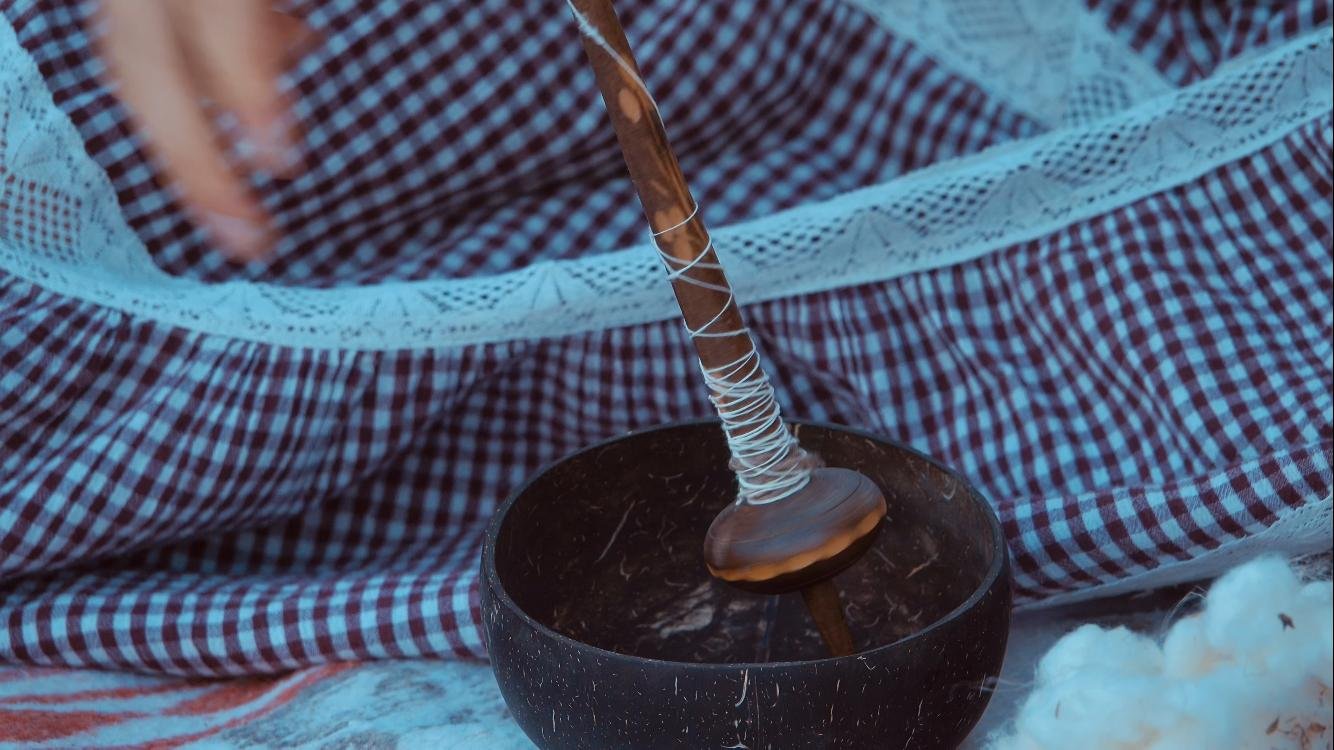
“The Woven Sounds” is project by Mehdi Aminian and his team and aims at documenting the intangible cultural heritage, the singing style, music styles around the process of carpet weaving in Iran.
If I don’t do this, I go crazy. These are the words of an 84-year-old woman from Amiriyeh, Damghan, Iran, who still weaves Karbas every day—a craft with over 300 years of history. A life once built entirely by hand, from spinning thread to dyeing yarn.
Hidden in the valleys of Kashmir, Pashmina isn’t just a fabric—it’s a story of tradition, craftsmanship, and resilience. From the high-altitude Changthangi goats to the skilled hands that weave magic, this documentary unravels the journey of the world’s finest wool. Witness the art, the struggle, and the legacy of Pashmina.
This is the story of a unique group of craftswomen. Follow their journey as they return to creating the world-class embroidery that made their ancestors famous. The incredible stories of the women from the Kutch Mahila Vikas Sangathan co-operative (KMVS) are recorded here through video, song, laughter, and stitch. History here is worn as generations of knowledge are passed down through embroidered designs. Long a valuable item of trade, the embroideries also provide a common ground for women to meet and bring their stories to the world. Experience the amazing landscape of the Kachchh (Kutch) Desert on India’s western border, the remarkable diversity of the communities who live here, and the breathtaking colours of their textiles.
There is a village just outside Calcutta, India, where every family has a hand loom. As you pass the houses, the air is pierced by the “clack–clack–clack” of flying shuttles. In the family courtyards, threads are starched, warps are prepared, and bolts of finished cloth are evaluated with discerning eyes. In an age when cloth manufacture is dominated by computer-driven industrial mills, what are the virtues of hand weaving? What is the magic of the hand-loomed cloth?
Filmed in Cusco, Peru Wisdom Weavers is part of a series of videos by Kornhuber and Richie promoting older artists at work and the benefits of a lifelong creative practice to individual and community health. Together with Peruvian neurologist Maritza Pintado-Caipa and photojournalist Johnny Miller, Kornhuber and Richie visited villages in the rural Peruvian Andes to learn about the art and impact of weaving. Patterns and designs — and the techniques that produce them — are passed down by grandparents to their children and grandchildren. From the finger choreography of belt weaving, to the sophisticated mechanics of building a loom, villagers share textile traditions that express the importance of their civilization while exercising their creativity and concentration.
Enter into the lives of two accomplished Maya weavers as they accept the challenge of weaving traditional blouses or huipiles in less than 90 days, from the purchase of threads to the last stitch. Manuela Canil Ren of Chichicastenango and Esperanza Pérez of San Antonio Aguas Calientes, Guatemala, expertly share the art of back-strap weaving at its finest and most colorful. They also offer touching insights into their own lives and hearts, as they struggle daily to support their families and keep their culture alive.
Through embroidered maps, families in the Sierra Tarahumara keep their homeland alive. In Chihuahua City, Mexico, Rarámuri families from Coloradas de la Virgen keep their home in the Sierra Tarahumara alive through ritual, memory, and thread. This episode follows their narrative embroidery, showing how, amid violence and displacement, storytelling turns into a form of remembrance, resistance, and survival.
Mushrooms are now widely used as a source for natural dyes. Many dyers today may not know that it all began with an accidental discovery by Miriam Rice, an artist from Mendocino, California. Miriam would later write the first book on using mushrooms as a source of natural dyes in the 1970’s called “Let’s Try Mushrooms for Color.” This groundbreaking dye book was illustrated by my Mom, Dorothy Beebee. Here, Dorothy gives us a behind the scenes look into one slice of the early history of mushroom dyes, the expansion of their work into two additional books, and her thoughts on the future of mushroom dyes.
This short film follows two Navajo weavers whose work preserves memory, identity, and ancestral knowledge. Through traditional techniques and contemporary expression, their art becomes a living story of resilience. Weaving emerges as a space of healing, continuity, and cultural strength.
Ukrainian’s Hutsul ethnic minority is keeping a century-old weaving tradition alive by using the same tools and techniques that their people have for generations. In war and in peace, they’re determined to keep their craft alive. We visited their village in Western Ukraine to see how their tradition is still standing.
Master Chiara Vigo welcomes us into a place where something almost unimaginable can be found. The Museum of Byssus in Sant’Antioco, Sardinia, holds a world of stories woven from ancient knowledge passed down through generations, with byssus at its heart.
Chiara Vigo, one of the last living witnesses of a tradition that risks disappearing, speaks in person to visitors of the museum, telling the story herself. She explains how byssus — the filament produced by the largest bivalve shell in the Mediterranean, the Pinna Nobilis or noble pen shell, which the creature secretes to anchor itself to the seafloor — was once harvested during a precise period of the year. Divers would descend using a technique carefully designed not to harm or kill the shell itself, taking only what the animal could spare.
If you know beautiful documentaries or short films about weaving and pottery traditions, let me know!